Risk assessments are the backbone of effective health and safety management. When done well, they reduce accidents, protect employees, and demonstrate compliance with UK legislation — particularly the Management of Health and Safety at Work Regulations 1999. But even experienced managers and safety professionals fall into predictable traps. These risk assessment mistakes weaken controls, expose organisations to enforcement action, and create blind spots that put people at risk.
This guide breaks down the most common errors, explains why they happen, and provides practical steps — grounded in HSE risk assessment guidance — to help you avoid them.
Not Identifying All Relevant Hazards
One of the biggest and most frequent mistakes is failing to identify every hazard present in a task, process, or environment. Many organisations focus only on obvious physical hazards (machinery, slips, trips) and overlook less visible risks such as:
Stress and fatigue
Lone working
Chemical exposure
Ergonomic strain
Noise and vibration
Psychosocial risks
Environmental conditions
Why This Happens
People tend to assess familiar tasks quickly, assuming they already understand the risks. This leads to complacency and missed hazards.
How to Avoid It
Walk the site and observe real working conditions.
Speak to employees — they often know risks managers don’t.
Use HSE templates and checklists to broaden your scope.
Review accident, incident, and near‑miss data for clues.
Consider non‑routine tasks such as maintenance, cleaning, and emergency situations.
Using Generic or Copy‑and‑Paste Assessments
Generic assessments are one of the most criticised issues in HSE risk assessment guidance. A risk assessment must reflect the specific environment, people, equipment, and processes involved. Copy‑and‑paste documents rarely do this.
Why This Happens
Time pressure, lack of training, or a belief that “something is better than nothing” leads organisations to reuse old templates.
How to Avoid It
Tailor every assessment to the task and location.
Include photographs to demonstrate real conditions.
Update assessments whenever processes change.
Ensure each control measure is relevant and achievable.
Generic assessments may tick a box, but they won’t stand up to scrutiny during an HSE inspection.
Failing to Consider Vulnerable Workers
Risk assessments must account for individuals who may be at greater risk, including:
Young workers
Pregnant workers
People with disabilities
Inexperienced staff
Contractors unfamiliar with the site
Older workers
Night‑shift workers
Why This Happens
Assessors often focus on the task rather than the people performing it.
How to Avoid It
Add a section specifically addressing vulnerable groups.
Consult HR and occupational health where needed.
Adjust controls to suit individual capability and needs.
Underestimating the Severity or Likelihood of Harm
Many organisations unintentionally downplay risk levels. This leads to inadequate controls and a false sense of security.
Why This Happens
Lack of understanding of risk matrices
Optimism bias (“It won’t happen here”)
Pressure to keep risk ratings low
How to Avoid It
Use evidence: incident data, industry statistics, manufacturer guidance.
Challenge assumptions — especially when risks are rated “low”.
Involve multiple people in scoring to reduce bias.
Not Implementing Control Measures Properly
A risk assessment is only useful if its control measures are actually put in place. Many organisations fail at this stage.
Why This Happens
Controls are unrealistic or too expensive
Responsibilities are unclear
No follow‑up or monitoring
Lack of training or supervision
How to Avoid It
Assign clear responsibilities and deadlines.
Ensure controls follow the hierarchy of control (eliminate, substitute, engineer, administrate, PPE).
Train staff on new procedures.
Monitor compliance through audits and inspections.
Ignoring Human Factors
Human behaviour plays a huge role in risk. Fatigue, stress, distraction, workload, and culture all influence how safely people work.
Why This Happens
Risk assessments often focus solely on physical hazards.
How to Avoid It
Include human factors in every assessment.
Consider shift patterns, workload, and environmental conditions.
Assess whether controls rely too heavily on human behaviour (e.g., “workers must remember to…”).
Not Reviewing Risk Assessments Regularly
Risk assessments must be reviewed:
After an accident or near miss
When equipment changes
When processes change
When new staff join
When legislation changes
At least annually for most workplaces
Why This Happens
Organisations assume risk assessments are “done” once completed.
How to Avoid It
Schedule annual reviews.
Use digital reminders or compliance software.
Encourage staff to report changes that may affect risk.
Poor Documentation and Record Keeping
Incomplete or unclear documentation is a common compliance issue.
Why This Happens
Assessors rush the process or lack training in writing clear, audit‑ready documents.
How to Avoid It
Use structured templates aligned with HSE guidance.
Include photos, diagrams, and evidence of controls.
Keep version control and update logs.
Ensure assessments are accessible to all staff.
Not Involving Employees in the Process
HSE guidance is clear: risk assessments must involve workers. They understand the job better than anyone.
Why This Happens
Managers often complete assessments alone or rely solely on supervisors.
How to Avoid It
Hold short hazard‑spotting sessions with staff.
Encourage open reporting of risks.
Include employee feedback in the final document.
Over‑Reliance on PPE
PPE is the last resort in the hierarchy of control, yet many organisations use it as the first.
Why This Happens
PPE is cheap, quick, and easy to implement — but it does not remove the hazard.
How to Avoid It
Prioritise elimination, substitution, and engineering controls.
Use PPE only when other controls cannot fully reduce risk.
Ensure PPE is suitable, maintained, and worn correctly.
Failing to Communicate the Findings
A risk assessment is useless if employees don’t know what’s in it.
Why This Happens
Documents are stored away and never shared or explained.
How to Avoid It
Brief staff during toolbox talks.
Display key controls on posters or digital screens.
Provide training for high‑risk tasks.
Ensure contractors receive relevant assessments before starting work.
RAMS vs Risk Assessments: What Employers Must Know
RAMS vs Risk Assessments: What’s the Difference?
If you work in construction, manufacturing, property management, or any sector with hands‑on tasks, you’ve likely heard the terms risk assessment and RAMS used together. They’re closely linked—but they’re not the same thing. Understanding the difference is essential for compliance, contractor management, and keeping people safe.
This guide breaks down RAMS meaning, how RAMS and risk assessments work together, and when your business needs each one.
What Is a Risk Assessment?
A risk assessment is a legal requirement under the Management of Health and Safety at Work Regulations 1999. Its purpose is simple: Identify hazards, evaluate risks, and implement controls to prevent harm.
A compliant risk assessment will:
Identify hazards in a task, process, or environment
Assess who may be harmed and how
Evaluate the level of risk
Specify control measures
Record findings
Review and update regularly
Risk assessments are the foundation of safe working—they tell you what could go wrong and how to stop it.
RAMS Meaning: What Are RAMS?
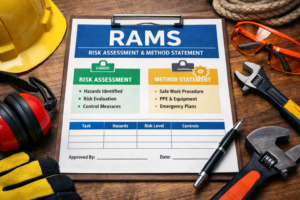
RAMS stands for Risk Assessment and Method Statement. It combines two documents:
Risk Assessment – the hazard and risk evaluation
Method Statement – a step‑by‑step safe working procedure
A method statement explains how a task will be carried out safely, using the controls identified in the risk assessment.
A RAMS document is typically required for:
Construction work
High‑risk activities (e.g., hot works, working at height, confined spaces)
RAMS are more detailed and task‑specific than a standalone risk assessment.
RAMS vs Risk Assessment: The Key Differences
Aspect
Risk Assessment
RAMS
Purpose
Identify hazards and control risks
Provide a safe working procedure
Legal Requirement
Yes
Not always, but widely expected
Detail Level
High-level hazard evaluation
Step-by-step instructions
Audience
Managers, supervisors, H&S professionals
Workers carrying out the task
Format
Hazard-based
Instruction-based
When Used
All work activities
Higher-risk or client-required tasks
In short: A risk assessment tells you what the risks are. A method statement tells you how to do the job safely. Together, they form RAMS.
Why RAMS Are Important for Employers and Contractors
RAMS provide clarity, consistency, and confidence. They help ensure that:
Workers understand the safe system of work
Clients can verify contractor competence
Supervisors can brief teams effectively
High‑risk tasks are controlled and documented
Compliance is demonstrated during audits or inspections
For many clients—especially in construction, FM, and property management—RAMS are a mandatory requirement before work begins.
What Should a Good Method Statement Include?
A strong method statement guide will cover:
Scope of work
Responsibilities and supervision
Sequence of operations
Tools, equipment, and plant
PPE requirements
Control measures from the risk assessment
Emergency procedures
Environmental considerations
Site-specific hazards
Permits to work (if applicable)
A method statement should be clear, practical, and written in plain language so workers can follow it easily.
assessment.
When Do You Need RAMS Instead of Just a Risk Assessment?
You should produce RAMS when:
The task is complex or high-risk
You are working on a client site
Contractors are involved
CDM regulations apply
The client requests RAMS as part of pre‑qualification
You need a safe system of work for briefing teams
For lower-risk, routine activities, a risk assessment alone may be sufficient.
Final Takeaway
Risk assessments and RAMS are both essential tools—but they serve different purposes. A risk assessment identifies hazards and controls. A method statement explains how to carry out the task safely. Together, they form RAMS: a complete safe system of work that protects people, satisfies clients, and supports legal compliance.
How to Write a Risk Assessment: Step‑by‑Step Guide for Employers
If you’re an employer in the UK, knowing how to write a risk assessment isn’t just good practice — it’s a legal requirement under the Management of Health and Safety at Work Regulations 1999. A clear, structured risk assessment protects your employees, reduces incidents, and demonstrates compliance during audits, inspections, and insurance reviews.
This step‑by‑step guide walks you through the full process, using terminology and expectations aligned with UK regulators such as the HSE. You can use this as a practical reference or pair it with your own risk assessment template UK to streamline documentation.
1. Identify the Hazards
Start by walking around the workplace and observing activities, equipment, substances, and behaviours.
Use incident reports, near‑miss logs, and manufacturer instructions to ensure nothing is missed.
2. Decide Who Might Be Harmed and How
A compliant UK risk assessment must specify who is at risk. This includes:
Employees
Contractors
Visitors
Members of the public
Young workers, new starters, pregnant workers, or anyone with additional needs
Describe how harm could occur — for example: “Employees may suffer musculoskeletal injuries from repetitive lifting.”
3. Evaluate the Risks and Decide on Controls
This is where you assess the likelihood and severity of harm, then decide on suitable control measures. Use the hierarchy of control:
Eliminate the hazard
Substitute with something safer
Engineering controls
Administrative controls
PPE (last resort)
For example:
Replace a hazardous cleaning chemical with a safer alternative
Install guarding on machinery
Introduce training and safe‑system‑of‑work procedures
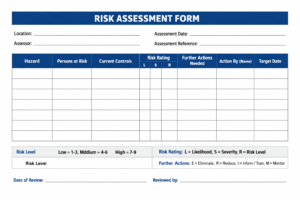
A risk assessment template UK usually includes a scoring matrix (e.g., 1–5 for likelihood and severity) to calculate risk levels before and after controls.
4. Record Your Findings
If you employ five or more people, you must record your assessment. Even if you don’t, written evidence is strongly recommended.
Your record should include:
The hazards
Who may be harmed
Existing controls
Additional actions required
Responsible persons
Timescales
Residual risk rating
This is where a structured risk assessment template UK helps maintain consistency and audit readiness.
5. Implement the Control Measures
A risk assessment is only effective if the actions are completed. Ensure:
Staff receive training
Procedures are updated
Equipment is installed or maintained
Supervisors monitor compliance
Assign responsibilities clearly and set realistic deadlines.
6. Review and Update Regularly
Risk assessments must be reviewed:
Annually (best practice)
After an incident or near miss
When new equipment, processes, or chemicals are introduced
When staffing or layout changes
If legislation or guidance changes
Regular reviews ensure your assessment remains accurate and defensible.
Get in touch with us for further information on Risk Assessments
Do I Need a Competent Person for Health & Safety? Legal Requirements Explained
If you run a business in the UK—even a small one—you must appoint a competent person for health and safety. This isn’t optional, and it isn’t just for high‑risk industries. It’s a legal requirement under the Management of Health and Safety at Work Regulations 1999 (MHSWR), and it applies to every employer.
Here’s a clear, structured breakdown of what the law expects, what “competence” really means, and how to decide whether you can take on the role yourself or need external support.
What Is a “Competent Person” in Health & Safety?
The term comes directly from UK law. A competent person is someone with the skills, knowledge, experience, and training to help you meet your health and safety legal duties. According to the HSE competent person guidance, this individual must be able to:
Identify hazards and evaluate risks
Understand relevant legislation
Advise on practical control measures
Support you in implementing safe systems of work
Help you stay legally compliant
The competent person can be:
You (the employer)
An employee
A combination of people
An external consultant
The key is that they must genuinely be competent—not just nominated.
The Legal Requirement: What the Law Actually Says
Under Regulation 7 of the MHSWR 1999, every employer must:
“Appoint one or more competent persons to assist them in undertaking the measures needed to comply with the requirements and prohibitions imposed upon them by health and safety law.”
This means:
You cannot legally operate without appointing someone
You must ensure they are competent
You must provide them with the resources and authority to do the job
Failing to appoint a competent person is a breach of your health and safety legal duties and can lead to enforcement action, fines, or prosecution.
What Counts as “Competence”?
Competence isn’t defined by a single qualification. Instead, it’s a blend of:
Knowledge of health and safety law and best practice
Experience applying that knowledge in real workplaces
Training relevant to your industry
Skills to assess risks and implement controls
For low‑risk businesses, basic training and experience may be enough. For higher‑risk sectors—construction, manufacturing, logistics—you’ll need someone with deeper technical expertise.
Can I Be My Own Competent Person?
Yes—if you are genuinely competent.
You can act as your own competent person when:
Your business is low‑risk
You understand your legal duties
You have appropriate training (e.g., IOSH Managing Safely)
You can dedicate time to the role
However, many business owners choose external support because:
They don’t have the time
They’re unsure about compliance
Their industry has higher risks
They want reassurance from a qualified professional
When You Need an External Competent Person
You should consider appointing an external HSE competent person if:
You lack internal expertise
Your operations involve significant hazards
You need help with risk assessments, policies, or audits
You want accredited, professional support
You’re scaling and need more robust systems
External competent persons often bring:
NEBOSH‑qualified expertise
Up‑to‑date legal knowledge
Industry‑specific experience
Documentation, templates, and ongoing support
For many SMEs, this is the most efficient and compliant route.
What a Competent Person Actually Does
A competent person typically supports you with:
Health & safety policy creation and review
Risk assessments and method statements
Accident investigation
Fire safety and emergency planning
Training and toolbox talks
Compliance audits
Contractor management
Ongoing advice and updates
Their role is to help you meet your health and safety legal duties—not to take responsibility away from you. The employer always remains legally accountable.
How to Choose the Right Competent Person
Look for someone who has:
Relevant qualifications (NEBOSH, IOSH, NVQs)
Experience in your sector
Accreditation or membership (e.g., IOSH, IIRSM)
Clear communication and practical advice
A proactive, supportive approach
Avoid anyone offering “tick‑box” compliance. The competent person should help you build a safer, more efficient workplace—not just paperwork.
Final Thoughts
Yes—you do need a competent person for health and safety. It’s a legal requirement, and it’s essential for protecting your people and your business.
Whether that’s you, an employee, or an external consultant depends on your competence, your risk profile, and your capacity.
Getting this right isn’t just about compliance—it’s about creating a safer, more confident, and more productive workplace.
If you want, I can help you turn this into a branded landing page, SEO‑optimised article, or downloadable guide tailored to your consultancy.
What Is a Health & Safety Policy? A Simple Guide for UK Businesses
For any UK business—whether you employ one person or one hundred—having a health and safety policy isn’t just a box‑ticking exercise. It’s a legal requirement and a practical tool that helps you protect your people, your reputation, and your organisation’s long‑term resilience.
If you’ve ever wondered “What is a health and safety policy?” or “Do I really need one?”, this guide breaks it down in simple, actionable terms.
What Is a Health & Safety Policy?
A health and safety policy is a written commitment that sets out:
Your organisation’s approach to managing health and safety
Who is responsible for what
How risks will be controlled in practice
Think of it as your organisation’s blueprint for keeping people safe. It shows employees, clients, insurers, and regulators that you take your responsibilities seriously.
In the UK, the Health and Safety at Work etc. Act 1974 requires every employer to have a policy. If you employ five or more people, it must be written down.
Why UK Businesses Need a Health & Safety Policy
A strong health and safety policy UK businesses can rely on does more than meet legal requirements. It:
Reduces accidents, incidents, and near misses
Demonstrates compliance to insurers, clients, and accreditation bodies
Builds trust with employees and contractors
Supports tender applications and pre‑qualification questionnaires
Helps you manage risks consistently and confidently
For small businesses, it’s often the first step toward a safer, more organised workplace.
The Three Essential Parts of a Health & Safety Policy
Every UK health and safety policy must include three core sections:
1. Statement of Intent (Your Commitment)
A clear, signed declaration from the most senior person in the business. It outlines your commitment to maintaining safe working conditions and complying with legislation.
2. Responsibilities (Who Does What)
This section defines roles and accountability, such as:
Directors and senior leaders
Managers and supervisors
Employees
Competent persons or external consultants
Clear responsibilities prevent confusion and ensure safety isn’t left to chance.
3. Arrangements (How You Manage Safety Day‑to‑Day)
This is the practical part—how you control risks. It may include:
Risk assessments
Training and competence
Fire safety
First aid
Incident reporting
Contractor management
Equipment maintenance
Hazardous substances
Lone working
Your arrangements should reflect what actually happens in your business, not generic statements.
How to Create a Health & Safety Policy That Works
A good policy is:
Clear – no jargon, no fluff
Relevant – tailored to your activities
Up to date – reviewed annually or after significant change
Communicated – shared with staff, contractors, and stakeholders
Implemented – backed by real action, not just paperwork
If your policy sits in a drawer, it’s not doing its job.
Final Thoughts
A health and safety policy is more than a legal requirement—it’s a foundation for a safer, more resilient business. Whether you’re a growing SME or a specialist consultancy, getting your policy right sets the tone for everything else you do.
Get in touch with us for free advice on your Health and Safety Policy
2026 Health & Safety Checklist for UK Small Businesses: Simple Steps to Meet HSE Requirements
Your essential guide to staying compliant, reducing risk, and protecting your workforce
Health and safety legislation continues to evolve, and 2026 brings renewed expectations for UK employers to demonstrate strong compliance, effective risk management, and a proactive approach to workplace safety. Whether you run a small business or manage a large organisation, having a clear, up‑to‑date health and safety checklist is essential for meeting your legal duties and creating a safe working environment.
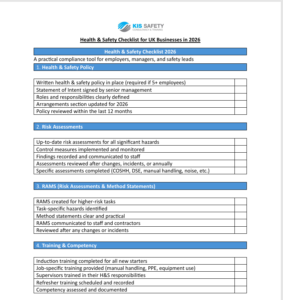
This comprehensive Health & Safety Checklist for UK Businesses in 2026 will help you review your current arrangements, identify gaps, and plan improvements for the year ahead.
1. Review Your Health & Safety Policy
Every UK business with five or more employees must have a written health and safety policy. In 2026, this should include:
• A clear Statement of Intent
• Defined roles and responsibilities
• Detailed arrangements for managing risks
• Evidence of regular review (at least annually)
If your policy hasn’t been updated in the last 12 months—or your operations have changed—it’s time for a refresh.
2. Ensure Risk Assessments Are Current
Risk assessments remain the backbone of workplace safety. Employers must:
• Identify hazards
• Evaluate risks
• Implement control measures
• Record findings
• Review assessments regularly
In 2026, HSE continues to emphasise proportionate, practical risk assessments rather than excessive paperwork. If your assessments are outdated or generic, they may not meet legal standards.
3. Update Your RAMS (Risk Assessments & Method Statements)
For higher‑risk industries such as construction, manufacturing, warehousing, and maintenance, RAMS are essential.
Check that your RAMS:
• Reflect current working practices
• Include task‑specific hazards
• Are communicated clearly to staff and contractors
• Are reviewed after incidents or changes in process
4. Check Staff Training & Competency
Training must be relevant, up to date, and recorded. In 2026, employers should ensure:
• Induction training is completed for all new starters
• Role‑specific training (e.g., manual handling, working at height, COSHH) is current
• Supervisors and managers understand their responsibilities
• Refresher training is scheduled and documented
Competency is not just training—it’s training + experience + supervision.
5. Review Fire Safety Arrangements
Under the Regulatory Reform (Fire Safety) Order, employers must:
• Complete a fire risk assessment
• Maintain fire alarms, extinguishers, and emergency lighting
• Provide clear evacuation routes
• Train fire marshals
• Conduct regular fire drills
If your building layout or occupancy has changed, your fire risk assessment must be updated.
6. Inspect Workplace Equipment & Premises
Regular inspections help prevent accidents and demonstrate compliance.
Check:
• Machinery and tools
• Electrical systems (PAT and fixed wiring)
• Lifting equipment (LOLER)
• Pressure systems (PSSR)
• Ventilation and welfare facilities
• Housekeeping and walkways
Record all inspections and maintenance activities.
7. Review Your Accident & Incident Reporting System
Your business must have a clear process for:
• Reporting accidents
• Recording near misses
• Investigating incidents
• Taking corrective action
• Meeting RIDDOR reporting requirements
Near‑miss reporting is especially valuable for preventing future harm.
8. Check Your First Aid Provision
Under the Health and Safety (First-Aid) Regulations, you must:
• Conduct a first‑aid needs assessment
• Provide trained first aiders or appointed persons
• Maintain stocked first‑aid kits
• Display first‑aid information clearly
If your workforce size or risk profile has changed, reassess your provision.
9. Review Contractor Management Procedures
If you use contractors, you must ensure they are competent and safe.
Check that you:
• Vet contractors before work begins
• Provide site‑specific inductions
• Share relevant risk assessments
• Monitor contractor activities
• Review performance after work is completed
Poor contractor management is a common cause of incidents.
10. Strengthen Your Safety Culture
A positive safety culture improves compliance, morale, and productivity.
In 2026, focus on:
• Encouraging open communication
• Recognising safe behaviour
• Involving staff in decision‑making
• Providing clear leadership
• Addressing concerns promptly
A strong culture reduces accidents and boosts engagement.
Need Help Staying Compliant in 2026?
If you want expert support with your health and safety responsibilities, our consultancy provides:
• Health & Safety Policies
• Risk Assessments & RAMS
• Competent Person Services
• Site Inspections & Audits
• Training & Compliance Support
• Retained Advisor Packages
We help businesses stay safe, compliant, and confident all year round.
Downloads/FREE Trials/Contact US Centre
Download your health and safety checklist by clicking the orange button
Online Approved Video Training – How does it work?
These are just a few examples of the many mental health and well-being courses that can be covered in online video training. The specific courses covered will depend on the needs of the learners and the specific industry they are working in.
What business skills are covered with online video training ?
Online video training can cover a wide range of business skills, depending on the needs of the learners and the specific industry they are working in. Some common business skills that are covered in online video training include:
Developing Teamwork: Developing Teamwork is all about building stronger relationships within your team by getting to know each other better and creating the foundations for an exceptionally high performing group of people.
Time management: This covers topics such as prioritization, goal setting, and productivity.
Leadership skills: This course starts by introducing the basics of leadership and explores where the concept originated from. It then goes on to discuss various leadership theories, including situational leadership, contingency theories, transactional and transformational leadership and more.
Managing Meetings: The course starts with some basic definitions and statistics that outline how important running meetings effectively can be. It examines factors that make meetings great, and some practical steps you can take to ensure everything runs smoothly and successful outcomes are achieved. It also covers some of the ways you can handle any problems that may arise.
Sales Skills: The course will start by providing an overview of the basic rules for sales people, along with the right mindset, self-assessment and the goals you’ll need in the short, medium and long term. It’ll cover cold calling, including how to prepare, what to say and how to deal with gatekeepers as well as walking you through a typical face-to-face meeting.
Customer service: This covers topics such as communication skills, conflict resolution, dealing with difficult customers, and building customer relationships.
Stress Management: The Health and Safety Executive states that ‘work related stress develops because a person is unable to cope with the demands being placed on them’. This can come from any aspect of their life but it often comes from demands placed on them at work. So why is stress a problem in the workplace? Well the latest estimates show the total number of cases of work related stress depression or anxiety account for 39% of all work related illness .
These are just a few examples of the many business skills that can be covered in online video training. The specific skills covered will depend on the needs of the learners and the specific industry they are working in.
These are just a few examples of online video approved training, but if you require further information on the full range of courses, then please contact us here…..
Asbestos – Why is it so important to construction workers?
What is asbestos ?
Asbestos is a naturally occurring mineral that was once widely used in building materials and other products due to its excellent insulation and fire-retardant properties. It consists of long, thin fibres that can easily become airborne when disturbed, and when inhaled, these fibres can lodge in the lungs and cause serious health problems, such as lung cancer, mesothelioma, and asbestosis. Due to its dangerous health effects, asbestos has been banned or restricted in many countries, and its use is strictly regulated in those where it is still allowed. However, many older buildings still contain asbestos, and its safe removal and disposal require specialized training and equipment.
Asbestos was used widely because of its unique properties. It is a natural, fibrous mineral that is resistant to heat, fire, chemicals, and electricity. It also has excellent insulation properties and is strong, durable, and flexible. Due to these properties, it was used in a wide range of products, including building materials such as insulation, roofing materials, and floor tiles; automotive parts such as brake pads and gaskets; and consumer goods such as hair dryers, ironing board covers, and even children’s toys.
Additionally, during the early to mid-20th century, when asbestos use was at its peak, the health risks associated with exposure to asbestos were not well understood. As a result, many manufacturers and builders saw asbestos as a cheap, effective, and safe material that could improve the performance and durability of their products. It was not until the 1960s and 1970s, when researchers began to link asbestos exposure to serious health problems, that the risks associated with asbestos became widely known.
What asbestos safeguards are there?
There are several safeguards in place to protect people from exposure to asbestos:
Asbestos regulations: Many countries have regulations in place that restrict or ban the use of asbestos, or require special precautions to be taken when handling or removing it. For example, in the United States, the Environmental Protection Agency (EPA) regulates asbestos under the Asbestos Hazard Emergency Response Act (AHERA) and the Clean Air Act (CAA).
Asbestos inspections: Before any renovation or demolition work is carried out on a building, an asbestos inspection should be conducted to determine if there is asbestos present. This will help to identify any potential hazards and ensure that proper precautions are taken.
Protective equipment: Workers who may be exposed to asbestos are required to wear appropriate protective equipment, such as respirators, disposable coveralls, and gloves, to prevent inhalation or ingestion of asbestos fibres.
Proper handling and disposal: Asbestos-containing materials must be handled and disposed of properly to prevent the release of asbestos fibers into the environment. This includes sealing off work areas, wetting down materials to minimize dust, and using special disposal techniques.
Training and certification: Workers who handle asbestos must be properly trained and certified to do so. This includes training on safe handling techniques, proper use of protective equipment, and awareness of the health hazards associated with asbestos exposure.
Public awareness: It’s important for the public to be aware of the risks associated with asbestos and how to prevent exposure. This includes information about the proper handling of asbestos-containing materials, and the importance of having an asbestos inspection before any renovation or demolition work is done.
What UK regulations control asbestos?
In the UK, the control of asbestos is regulated by the Control of Asbestos Regulations 2012 (CAR 2012), which are enforced by the Health and Safety Executive (HSE). These regulations cover all aspects of asbestos, from its use in buildings and products, to the management and removal of asbestos-containing materials.
Some key requirements of the CAR 2012 include:
Duty to manage asbestos: Under the regulations, owners and managers of non-domestic buildings have a duty to identify and manage asbestos-containing materials on their premises. This includes maintaining an asbestos register, conducting risk assessments, and putting in place a plan for managing and monitoring asbestos-containing materials.
Asbestos surveys: Before any work is carried out on a building, an asbestos survey must be conducted to determine if there is asbestos present. This will help to identify any potential hazards and ensure that proper precautions are taken.
Licensing of asbestos removal: The removal of certain types of asbestos-containing materials requires a license from the HSE. This includes work with higher-risk materials such as asbestos insulation, asbestos coating, and asbestos insulating board.
Training and certification: Workers who handle asbestos must be properly trained and certified to do so. This includes training on safe handling techniques, proper use of protective equipment, and awareness of the health hazards associated with asbestos exposure.
Air monitoring: During asbestos removal work, air monitoring must be conducted to ensure that asbestos fibres are not being released into the air. If the levels of asbestos fibres exceed the legal limit, work must be stopped until the situation is rectified.
Notification: If asbestos-containing materials are identified during work, the HSE must be notified in writing. This applies to all types of work, from minor repairs to major renovations and demolitions.
If I work in construction do I need asbestos training?
Yes, if you work in construction and may be exposed to asbestos as part of your job, you will need to have asbestos training. The Control of Asbestos Regulations 2012 requires employers to ensure that their workers who are likely to be exposed to asbestos receive adequate training. This includes workers involved in activities such as renovation, demolition, drilling, and maintenance that may disturb asbestos-containing materials.
The training should cover the following topics:
The properties of asbestos and its health effects
The types, uses, and likely occurrences of asbestos in buildings and products
The procedures for identifying and assessing asbestos-containing materials
The control measures to be taken to prevent exposure to asbestos
The proper use of personal protective equipment
The procedures for dealing with emergencies involving asbestos
The requirements for record-keeping and reporting incidents involving asbestos
There are different levels of asbestos training depending on the level of risk and the type of work being carried out. These range from asbestos awareness training for those who may come into contact with asbestos but are not expected to work with it, to more advanced training for those who will be carrying out work with asbestos-containing materials.
Abrasive Wheels – Understanding the Marking System
Abrasive wheels are used across many industries, this can include manufacturing, fabrication and construction.
The use of abrasive wheels can be extremely dangerous and as there are many different types of abrasive wheels and correspondingly uses of abrasive wheels. It is important that any one using an abrasive wheel, uses the correct wheel to do the correct function and fit it to the correct tool.
One way of making sure this happens, is by selecting the correct type of abrasive wheel for your machinery and to select the correct abrasive wheel to carry out specific grinding or cutting actions.
Manufacturers of abrasive wheels assist you in choosing the right abrasive wheel by providing them with a marking system. The marking system in the UK conforms to the standard which is set by the British Standards Institution (BSI), and the marking system is specified in BS EN 12413, “Safety requirements for bonded abrasive products“. The marking system is also standardized by the European Standards which specify the type of information that must be included on abrasive wheel labels.
This labelling system which is used, indicates:
1. Manufacturers trade mark
2.Test Record
3. Any restrictions of use #
4. Expiry Date (for organic bonded wheels)#
5. Speed Stripe#
6. Dimensions#
7. Specification Mark#
8. Code number
9. Maximum Operating Speed#
10. Type (BSEN12413) #
#Safety Related Markings
Safeguarding your New Apprentice
When I was 14 I moved to a new district in Sheffield. This area, whilst not far from my former home, had different preschools to mine. Several School districts had all mixed in at Comprehensive School the year previously and so there where many new faces to meet and get to know. Two such boys were in my daily registration form class and lived quite close to me, they were called John and Troy.
These two lads were inseparable and it was obvious to me they had been friends for a very long time, probably ever since Nursery School. John was the joker of the two, always doing pranks, telling stories and making Troy laugh.
When we all left School to start our new lives, I had opted to go
to College to learn about the world of business and John and Troy had got apprenticeships,
both working in factories. I would still see the lads occasionally on
the morning Bus, always sat together, chatting, John making Troy laugh and
generally enjoying each other’s company, just like they had always done.
One day I picked up the local news paper to read the tragic news
that John had been killed in an accident at work. He had fallen into a machine.
This was the first time in my life I had known someone who had
died. I reflected and recalled seeing John
and his father sat joking with each other at a parents open evening years
previously. I wondered how distraught his father must be at
losing his son.
The next time I saw Troy on the bus, he was understandably devastated. With a vacant look on his face, he was lost, empty and a shell of his former self. No longer did he have his best mate by his side.
A young person fresh into the world of work can often display naivety
towards the dangers and hazards that may be inherent to a work process. This behaviour, while common, can often be
overlooked by an employer and be the source of potential serious accidents. The
reality is, young people are owed the same duty of care as other employees and
therefore employers have the same responsibilities for health, safety and welfare.
For apprentices who are under 18,
the employer has the same responsibilities as for other young workers.
The responsibilities of a training provider, unless it is an Apprenticeship
Training Agency (see below), should be considered to be the same as those of a
work placement organiser – see ‘Training providers’ below.
How can you improve the situation **Apprenticeships Training Agencies (ATA). These organisations will source, arrange and find a host for an apprenticeship, the Agency is the apprentice’s employer. The ATA and the host organisation should work together to ensure risks are effectively controlled.
Below are key areas on how organisations should
cooperate to ensure the same level of health and safety protection is provided
in the workplace for apprentices hosted via this arrangement as for host
organisation’s employees.
The host company and ATA need to agree who does what with regard to the
apprentice. It should never be assumed that the ‘other side’ will take
responsibility:
Key areas to follow:
make sure, before apprentices start, that they are
covered by risk assessments, and they know what measures have been taken to
protect them
make sure apprentices understand the information
and instructions they need to work safely, and have had any necessary training
agree on arrangements for providing/maintaining any
personal protective equipment, display screen equipment eyesight tests, and any
necessary health surveillance
agree on arrangements for reporting relevant
accidents to the enforcing authority (usually HSE or the local authority)
Under the Conduct of Employment Agencies and Employment Businesses
Regulations 2003, agencies and businesses that use workers supplied by them
must exchange the information they both need to ensure the safety of workers.
Training providers include all those who arrange or fill apprentice
vacancies. This includes third party sub-contractors and also
includes those who are only involved in organising the off the job training
element of the apprenticeship.
The employer has the primary responsibility for the health and safety of
the apprentice and should be managing any significant risks. As the
training provider, you should take reasonable steps to satisfy yourself that
the employer is doing this
This does not mean trying to second guess an employer’s risk assessment
or risk control measures, and you are not required to carry out your own
workplace assessment
You can rely on past experience, for example, if the employer is
familiar to you and they have a good track record on health and safety.
You should keep checks in proportion to the environment:
For low risk environments, such as an office or
shop, with everyday risks that will mostly be familiar to the apprentice,
simply speaking with the employer to confirm this should be enough. This
can be part of any wider conversation on placement arrangements that may take
place.
For environments with less familiar risks, like
light assembly or packing facilities, talk to the employer to find out what the
apprentice will be doing and confirm the employer has arrangements for managing
risks, including induction, training, supervision, site familiarisation, and
any protective equipment that might be needed.
For higher risk environments such as construction,
agriculture or manufacturing, discuss with the employer what the apprentice
will be doing, the risks involved and how these are managed, satisfying
yourself that the instruction, training and supervisory arrangements have been
properly thought through.
Check the apprentice knows how to raise any health and safety concerns.
At KIS Safety we realise that this can be a minefield for all
parties concerned in organising apprenticeships for young people. With a wealth of experience across a range of
industries, KIS Safety can help you apply the principals as detailed above to
ensure the Young Apprentice will be working in a safe and healthy environment.