
RAMS vs Risk Assessments: What Employers Must Know
RAMS vs Risk Assessments: What’s the Difference?
If you work in construction, manufacturing, property management, or any sector with hands‑on tasks, you’ve likely heard the terms risk assessment and RAMS used together. They’re closely linked—but they’re not the same thing. Understanding the difference is essential for compliance, contractor management, and keeping people safe.
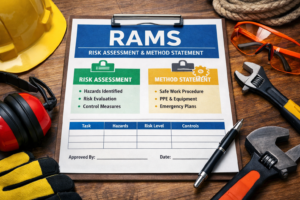
This guide breaks down RAMS meaning, how RAMS and risk assessments work together, and when your business needs each one.
What Is a Risk Assessment?
A risk assessment is a legal requirement under the Management of Health and Safety at Work Regulations 1999. Its purpose is simple: Identify hazards, evaluate risks, and implement controls to prevent harm.
A compliant risk assessment will:
- Identify hazards in a task, process, or environment
- Assess who may be harmed and how
- Evaluate the level of risk
- Specify control measures
- Record findings
- Review and update regularly
Risk assessments are the foundation of safe working—they tell you what could go wrong and how to stop it.
RAMS Meaning: What Are RAMS?
RAMS stands for Risk Assessment and Method Statement. It combines two documents:
- Risk Assessment – the hazard and risk evaluation
- Method Statement – a step‑by‑step safe working procedure
A method statement explains how a task will be carried out safely, using the controls identified in the risk assessment.
A RAMS document is typically required for:
- Construction work
- High‑risk activities (e.g., hot works, working at height, confined spaces)
- Contractor operations
- Client‑led compliance requirements (e.g., property management, FM, CDM sites)
RAMS are more detailed and task‑specific than a standalone risk assessment.
RAMS vs Risk Assessment: The Key Differences
| Aspect | Risk Assessment | RAMS |
|---|---|---|
| Purpose | Identify hazards and control risks | Provide a safe working procedure |
| Legal Requirement | Yes | Not always, but widely expected |
| Detail Level | High-level hazard evaluation | Step-by-step instructions |
| Audience | Managers, supervisors, H&S professionals | Workers carrying out the task |
| Format | Hazard-based | Instruction-based |
| When Used | All work activities | Higher-risk or client-required tasks |
In short: A risk assessment tells you what the risks are. A method statement tells you how to do the job safely. Together, they form RAMS.
Why RAMS Are Important for Employers and Contractors
RAMS provide clarity, consistency, and confidence. They help ensure that:
- Workers understand the safe system of work
- Clients can verify contractor competence
- Supervisors can brief teams effectively
- High‑risk tasks are controlled and documented
- Compliance is demonstrated during audits or inspections
For many clients—especially in construction, FM, and property management—RAMS are a mandatory requirement before work begins.
What Should a Good Method Statement Include?
A strong method statement guide will cover:
- Scope of work
- Responsibilities and supervision
- Sequence of operations
- Tools, equipment, and plant
- PPE requirements
- Control measures from the risk assessment
- Emergency procedures
- Environmental considerations
- Site-specific hazards
- Permits to work (if applicable)
A method statement should be clear, practical, and written in plain language so workers can follow it easily.
assessment.
When Do You Need RAMS Instead of Just a Risk Assessment?
You should produce RAMS when:
- The task is complex or high-risk
- You are working on a client site
- Contractors are involved
- CDM regulations apply
- The client requests RAMS as part of pre‑qualification
- You need a safe system of work for briefing teams
For lower-risk, routine activities, a risk assessment alone may be sufficient.
Final Takeaway
Risk assessments and RAMS are both essential tools—but they serve different purposes.
A risk assessment identifies hazards and controls.
A method statement explains how to carry out the task safely.
Together, they form RAMS: a complete safe system of work that protects people, satisfies clients, and supports legal compliance.
Get in touch with us for free advice on your RAMS